Croc Farm Project

LINEA img 1

Pongola is regarded as the most fertile farming lands in Kwa-zulu Natal, for sugar cane, its’s rand value per square mile is worth more in terms of quality lactose content, than found anywhere else in the KZN province. It’s natural irrigation system which comprises of water canals that run through the farming basin, providing plenty of water for the farms in the area. If one wasn’t aware of the existence of a farmer by the name of Coen La-buschagne you would be none the wiser to the existence of one of the first open air crocodile breeding facility’s in SA. Mr. Labuschagne’s farming something rather different to what greets you as you Pongola. Mr. Labuschagne is a crocodile farmer. Originally a chicken farmer from Vryhied, he chose Pongola because of the climate. Pongola has a very moderate climate perfect for farming crocodiles, the temperature remains moderate all year round peaking around 35 degrees Celsius in the summer months. Mr. Lubuschagne has been farming crocodiles for the past 12 years and started his farm with just 400 hatchlings, which he bought from a farm in Namibia. He now boasts an impressive 19500 crocodiles of all different sizes, purely for their skins, which he sends out to Europe, where they are then used to make luxury belts, hand bags and shoes. Farming crocodiles requires a lot of patience, 12 years on he is still building his stocks up, this just shows how dedicated he is to his business and his passion.

LINEA img 2

(above) The typical pond layout for the crocodiles once they are large enough they are moved to ponds like the ones pictured above. The water for the ponds is changed regularly and the clean water comes straight from the Pongola river and the canals in the area.

Interesting Facts

“19500 crocodiles eat 65 tons of feed a year”

“A female crocodile lay’s about 35 eggs and only 70% of those will survive”

“Mr. Labuschagne has conditioned his crocodiles to come to him when he calls them by clapping and shouting” “kom, kom, kom!”

Coen now has 600 “breeders” they have a life expectancy between 60-80 years.

LINEA img 3   LINEA img 4

Clearing the land and marking out the foundations for the 9m2 individual ponds of which there are 100 first phase. The ponds once completed will hold 60 baby crocodiles measuring 60cm in length, and 4 larger crocodiles.

LINEA img 5

The optimum temperature to accelerate the baby crocodiles growth and size is 32 degrees celsius

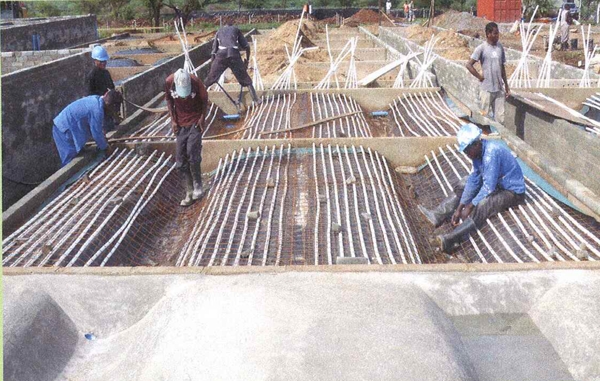
The ponds are bricked around a cast concrete form with holes that will accommodate the under floor heating pipes (pex/al/pex). This piping system is used around the world for under floor heating applications, due to the multilayer composite, the pipe retains the heat within giving a constant heating and smaller temperature variances between the flow and return lines, building the temperature of the slab up evenly throughout, not only reducing the need for larger boiler systems but reducing the cost of heating as well. The purpose of the ponds being heated is due to the precise optimum temperatures required to accelerate the crocodiles growth which can only be done during their first 12 months, by maintaining the environment temperature at precisely 32 degrees Celsius, this together with a high protein diet accelerates there growth. There after they are returned to a non- controlled environment.
 

LINEA img 6

(above) the long lengths of pipe used to consistently heat the slab to 32 degrees Celsius controlling the enclosed environment for optimum growth acceleration for the young crocodiles.


The multi-layered pipes are run through the formed concrete slabs and connect to a manifold system, that separates the flow and return lines. Heating the slab that will be cast over the pipes in both directions. One of the benefits of using the multi-layered 2025 pipe, which is equivalent to 22mm diameter metal and plastic pipes, is the long lengths it comes in (100m) eliminating the need for joint every 5.5 meters and hugely reduces the risk of leaks in the slab!

LINEA img 7

(above) The ends of the pipes are strapped together keeping the flow and return lines separate from each other making connecting to the mani-folds easier.


The pipes are then covered with sheet reinforcing to give strength to the slab and eliminate cracking during heating. The shape of the ponds is slightly angled on the sides and drops down in the center to where the water will be dammed to a depth of 40cm. The pipes in the slab will also help heat water to 32 degrees Celsius.

LINEA img 14"450 meters of pipe was used per line of five ponds, each pond is 9m2"

(above) an over view of the site showing the overall size of phase one and the lush cane fields in the surrounding background

LINEA img 8           LINEA img 9

(above) the custom designed manifold systems regulating the flow through the under floor heating pipes in the ponds.

“the manifolds are made of stainless steel tubing. The out lets are 6mm in diameter, this gives the required flow rate and reduces the amount of air in the system, and is supplied by a 100mm diameter pipe on the flow and return line”

LINEA img 10     LINEA img 11

(above) Installing the 4150 prefabricated bends and sections, which were transported to site in smaller sections and assembled. They are the heating coils for the 80 kilolitre reservoirs that will be pre-heated to 35 degrees Celsius before supplying the ponds holding the baby crocodiles. The tanks required a minimum of 70 meters of 50 mm diameter pipe to heat the quantity of water sufficiently. The fabricated pipes are raised from the floor of the tanks by 300mm allowing convection currents and increasing the heating efficiency of the entire system. The hot water in the tanks heating coils are supplied through a closed system from the coal boiler hot water storage tank and circulated through the pipes at a pressure of 200 KPA (2 bar).

LINEA img 12

Off loading the coal boiler.

LINEA img 13 

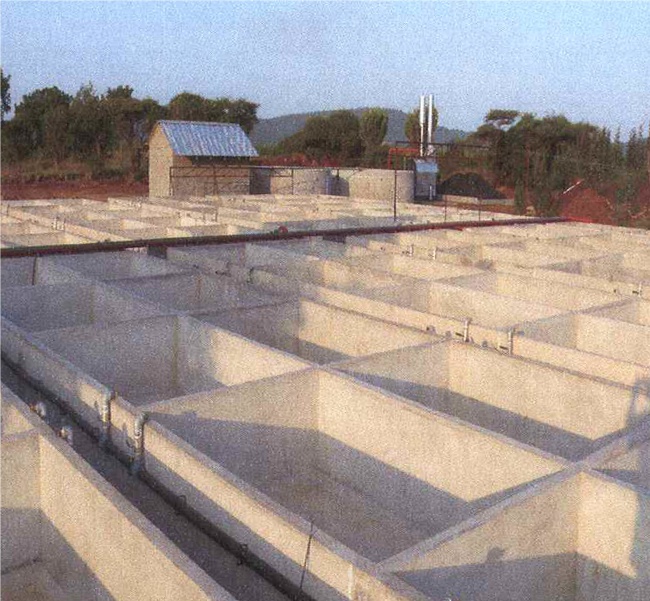
An overall view of the completed ponds, where the baby crocodiles will be kept. In the back ground you can see the two reservoirs and the pump house. On the far right of the picture you can see the fully installed boiler and local mound, which will be used to heat the water 65 degrees Celsius for the under floor heating in the slabs and the reservoir water.